Yes. All Sue Bee® honey contains 100% USA honey, packaged by the 180+ independent beekeepers who make up Sioux Honey Association Co-op, the largest honey cooperative in the U.S.
Yes. All Sue Bee® and Aunt Sue’s® honey is made by honeybees from the flower nectar they gather, transform, and store in honeycombs. There are no other ingredients or additives.
Honey is naturally free of allergens. No allergens are stored or used in our facilities.
No. Honey is composed primarily of carbohydrates.
Several antioxidants, including pinocembrin, pinobanksin, chrysin, galangin, ascorbic acid, catalase, and selenium, have been found in honey. Darker honeys with higher moisture content tend to have stronger antioxidant potential.
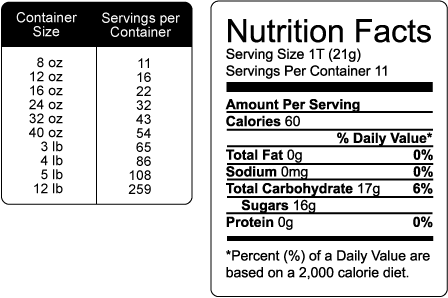
Based on USDA Nutrition Facts, one tablespoon contains less than 1 milligram of sodium, a level the FDA considers “sodium free.”
No. Honey is naturally free of trans fatty acids.
No. Safety and security concerns have made tours impractical.
Start by substituting honey for up to half the sugar called for. For baked goods, reduce the oven temperature by 25°F to prevent overbrowning, reduce any liquid in the recipe by 1/4 cup for each cup of honey used, and add 1/2 teaspoon of baking soda for each cup of honey. Because of its naturally high fructose content, honey has more sweetening power than sugar, so you can use less of it to achieve the same sweetness.
Sue Bee® is filtered to remove more hive debris, while Aunt Sue’s® is strained, leaving more pollen behind. Because of this, Aunt Sue’s® may crystallize a bit more over time (see Usage & Storage below for how to reverse this).
One tablespoon of honey contains about 60 calories.
Eight fluid ounces (1 cup) of honey weighs about 12 ounces, since honey is heavier than water and typically sold by weight rather than volume. A gallon of honey weighs approximately 12 pounds.
Keep honey in a sealed container at room temperature. Refrigeration preserves honey well but promotes granulation into a semi-solid mass. Freezing preserves honey well without promoting granulation, but makes it harder to dispense. Avoid temperatures above room temperature, which can darken honey and subtly change its flavor.
Yes. Honey naturally contains no wheat, barley, rye, or oats, or any of their by-products, and no gluten-containing products are stored or used in our facilities.
No. Honey is naturally very low in bacteria and other microbes and doesn’t benefit from pasteurization.
It would be improper for us to advise on a medical condition; please consult your doctor or nutritionist regarding your use of honey. For reference, honey is a complex solution of natural sugars, including fructose (38%), glucose (32%), sucrose (2%), maltose (7%), and other sugars, acids, and flavor compounds (4%). These carbohydrates should be accounted for in your diet.
Yes. Sue Bee® honey and Aunt Sue’s® Raw & Unfiltered Honey are certified Kosher by the Orthodox Union.
Most certified-organic honey comes from outside the U.S. and follows organic livestock standards; bees must gather nectar only from approved forage areas free of modern agriculture, urban development, highways, or other disqualifying land uses. Organic honey is certified by Quality Assurance International (QAI) to verify the product is truly organic.
Because honey is a natural product, its flavor is shaped by the type of flowers bees gather nectar from, as well as the geographical region and weather.
The general health of the U.S. bee population, weather, agricultural practices, and the economics of the honey industry all affect the number of bee colonies and their production. Like people, bees are vulnerable to diseases and parasites, sometimes at epidemic proportions.
Reach out to your local retailer and ask them to carry it. Grocers listen to their customers.
Crystallization is a natural characteristic of pure honey, not a sign it’s gone bad; it doesn’t harm the honey or indicate any deterioration. It happens because honey is a concentrated solution of glucose and fructose, and over time glucose can separate out and form crystals.
To reverse it, place the closed honey container into water that’s been brought to a near boil and removed from the heat (take the lid off first), and leave until both have cooled.
To help prevent it, pour a manageable amount into a smaller “table server” for everyday use and store the remainder in the freezer, where cold temperatures slow crystal formation; just make sure the table server has no existing crystals before refilling it, since they act as “seeds” that speed up granulation in new honey.
Spun® Honey is pure, premium honey that’s been allowed to naturally granulate under controlled conditions, creating a smooth, spreadable texture. It’s one of our most popular products. (Sue Bee® Spun® Clover Honey is a registered trademark of Sioux Honey Association Co-op.)
Honey doesn’t spoil, and it will keep indefinitely if stored in a sealed container at room temperature. It may darken and become a bit stronger in flavor with age, but flavor is best when enjoyed before the “best by” date on the cap.
Both are pure, natural honey; they’re just processed differently. Filtered honey, like our classic Sue Bee®, simply has visible particles from the hive removed. Raw and unfiltered honey, like Aunt Sue’s®, is strained instead, allowing more pollen to remain. Neither is better or worse in terms of food safety or quality; pollen isn’t required by the USDA, FDA, or any other U.S. standard, and no scientific evidence proves honey with pollen offers greater benefit. It comes down to personal preference.
Sioux Honey Association Co-op is our family of 180+ independent beekeepers across the USA. Together, we produce the Sue Bee® honey you know, as well as our Aunt Sue’s® Raw & Unfiltered Honey.
We have two brands of pure, premium honey. Sue Bee® is our classic clover honey, filtered to a smooth perfection and a staple since 1921. Aunt Sue’s® Raw & Unfiltered Honey is exactly as described: raw and unfiltered, available in wildflower or clover, offering bold flavor and the benefits of natural pollen.
Our honey comes directly from our co-op of 180+ independent beekeepers, all of whom we know by name. It’s not just where your honey comes from that matters, it’s who, and each of our beekeepers is passionate about providing the highest-quality honey.
Air is unavoidably mixed in during pumping and filling. Since honey is viscous, it tends to trap that air, which slowly rises to the top after filling, leaving a white ring of foam. Larger containers show more foam. It gradually dissipates as the trapped air bubbles burst.
There isn’t much research to confirm it, but some believe local honey may help relieve allergies, the idea being that local bees collect pollen from the same plants that cause nearby allergies. Beyond that, we believe it’s important to support local honey providers; Sioux Honey Association Co-op is proud of each of its 180+ independent beekeepers and the products that feature and support them in their own communities.
Many of our containers are PET plastic, which can warp at near-boiling temperatures, and some labels include foil, which can create excessive heat in a microwave. Honey is also thick and viscous, so it doesn’t heat evenly; hotspots can form that may cause sudden boiling and spattering, hot enough to degrade the honey’s flavor and color.
Join our newsletter to stay up to date.
By signing up, you agree to receive marketing emails from Sioux Honey Association Co-op. You can unsubscribe at any time.